Inquiry
Form loading...

Top 10 Aluminium Powder Paint Types for Global Buyers

Choosing the right Aluminium Powder Paint is more complex than matching a color chart. Global buyers must consider substrate, exposure, application method, film thickness, and curing conditions. A bright silver finish may look excellent indoors, yet fade near a coastal loading bay. Humidity matters. So does surface preparation.

Coatings specialist Dr. Elena Marquez explains, “A durable powder finish begins with the environment, not the color.” This practical view guides our selection of ten Aluminium Powder Paint types for international projects. The list compares metallic, textured, high-gloss, matte, heat-resistant, and protective formulations. It also considers appearance, adhesion, corrosion resistance, storage stability, and production consistency. These details often decide whether a coating performs reliably after installation.

Real projects are rarely perfect. A buyer may receive incomplete technical data. A fabricator may use a different oven profile. Small variations can change the final shade. That is why product specifications should be checked against current technical data sheets, test panels, and supplier quality records. Independent testing remains valuable when buildings face salt spray, strong sunlight, abrasion, or repeated cleaning.

This guide is designed for distributors, manufacturers, architects, and procurement teams. It avoids one-size-fits-all claims. Instead, it highlights practical trade-offs between visual appeal, durability, cost, and processing tolerance. Some recommendations may require further validation. That is not a weakness. It is a responsible part of choosing Aluminium Powder Paint for global applications.
Top 10 Aluminium Powder Paint Types for Global Buyers

How the 10 Types Are Classified by Resin, Finish, Cure, and Pigment

Top 10 Aluminium Powder Paint Types for Global Buyers

Aluminium powder paint is classified through four practical lenses: resin, finish, cure, and pigment. The ten common types include epoxy-aluminium, polyester-aluminium, epoxy-polyester hybrid, polyurethane, and acrylic systems. The finish group includes smooth, textured, and hammer-effect surfaces. Low-temperature-cure powders reduce heat exposure, while high-reflectance aluminium-pigmented powders target brighter metallic effects.

Resin controls adhesion, flexibility, and chemical resistance. Epoxy offers strong protection indoors, but sunlight can reduce its colour stability. Polyester generally performs better outdoors. Hybrid resin balances cost and performance, although results vary by formulation. Polyurethane can produce a cleaner appearance. Acrylic types support refined finishes but may demand tighter process control.

Smooth powders reveal substrate defects quickly. Textured finishes hide minor marks. Hammer finishes create visual depth, but appearance can change with spray settings.

The global powder coatings market was valued at about USD 15.6 billion in 2023, according to Grand View Research. MarketsandMarkets forecasts continued expansion through 2028, driven by durable, low-waste coating systems. These reports support aluminium powder paint’s commercial relevance, but they do not replace product testing.

Buyers should check cure temperature, pigment orientation, gloss retention, and film thickness. A metallic finish can look uneven. That risk is often underestimated. Sample panels remain essential before approving large international orders.
Epoxy, Polyester, and Hybrid Powders: The 3 Core Binder Families

For global buyers, aluminium powder paint choices usually sit within three binder families: epoxy, polyester, and hybrid. The ten practical types include epoxy interior, epoxy zinc-rich, epoxy high-build, super-durable polyester, TGIC polyester, TGIC-free polyester, acrylic polyester, epoxy-polyester hybrid, low-temperature hybrid, and textured hybrid powder. The best option depends on corrosion exposure, sunlight, substrate, and curing equipment.

Epoxy powders Epoxy powders provide strong adhesion and chemical resistance. They suit panels, machinery, and indoor aluminium parts, but sunlight can cause chalking.

Polyester powders Polyester powders perform better outdoors. Super-durable and TGIC-free grades support façades, windows, railings, and transport components.

Hybrid powders Hybrid powders combine epoxy hardness with polyester appearance. They are useful for sheltered furniture and appliances, not demanding exterior façades.

The data matters. Grand View Research estimated the global powder coatings market at about USD 12.7 billion in 2023, with continued growth expected through 2030. A 2024 MarketsandMarkets assessment also identifies architectural, automotive, and appliance uses as major demand areas. These reports describe powder coatings broadly, not aluminium-specific paint, so buyers should avoid treating every forecast as a product guarantee.

Small details decide performance: a 60–80 μm film, clean pretreatment, and a verified 180°C cure can matter more than a fashionable finish.

Field experience also shows a difficult truth: “weather-resistant” is not universal. Coastal salt, sharp edges, and incomplete curing can defeat an otherwise excellent powder.

Metallic, Hammered, Textured, and Clear-Coat Finishes Across 10 Types

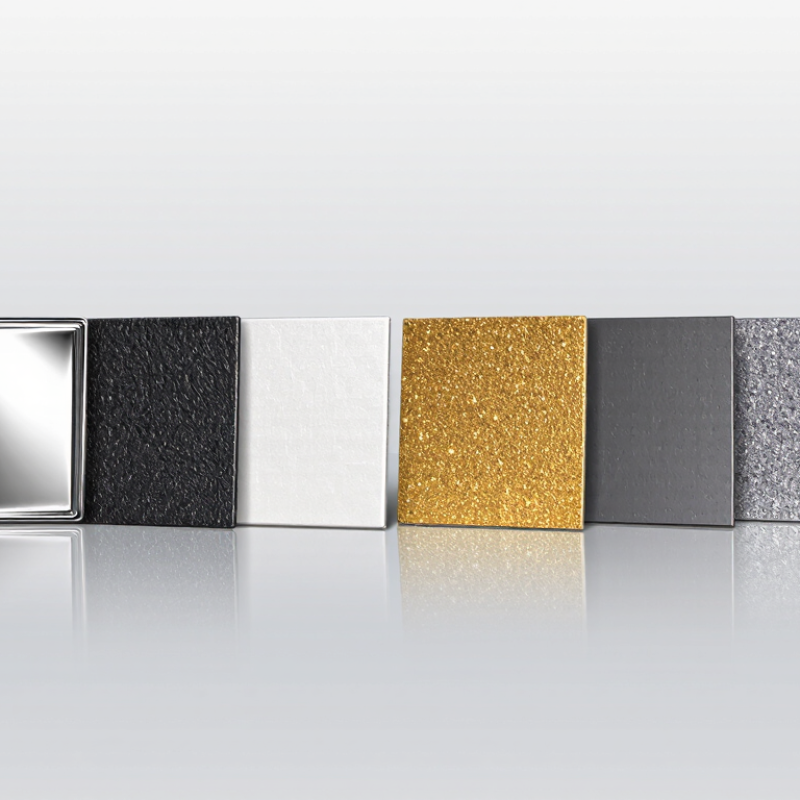
Aluminium powder paint offers more than a color choice. It controls reflection, touch, cleaning, and outdoor durability. The ten practical types include smooth solid, bright metallic, fine metallic, sparkle metallic, hammered, fine-textured, coarse-textured, wrinkle, clear-coat, and tinted clear-coat finishes. Metallic surfaces suit architectural panels and equipment needing a refined sheen. Hammered finishes hide minor handling marks and create a visible, uneven pattern. Textured coatings add grip and soften harsh reflections.

Clear-coat finishes protect decorative layers while preserving the base appearance. A transparent coat can deepen metallic effects, but it may also reveal surface defects. Tinted clear coats create warmer or darker visual effects. Fine textures are easier to clean than coarse textures, especially on gates, railings, and outdoor furniture. Wrinkle and sand textures provide stronger visual depth, although dirt can collect in their valleys. The result depends on pretreatment, film thickness, curing temperature, and application consistency.

Tips: Request physical panels before placing a large order. Check gloss under daylight and indoor lighting. Ask for tested adhesion, impact, and weathering data. Confirm the substrate and curing schedule. In one inspection, a beautiful metallic sample failed to match because the film was applied unevenly. That mistake was avoidable. Also, clear coats are not automatically suitable for every climate; humidity, salt exposure, and cleaning chemicals need separate review.

Performance Benchmarks: ISO 12944 C1–C5 and ASTM D3359 0B–5B

Top 10 Aluminium Powder Paint Types for Global Buyers
Performance Benchmarks: ISO 12944 C1–C5 and ASTM D3359 0B–5B

Aluminium powder paint can look bright, but appearance does not prove protection. In practical coating work, buyers should match the powder system with the expected corrosivity category. ISO 12944 C1 suits dry indoor spaces, while C2 covers low-risk rural environments. C3 demands stronger resistance for urban or moderately humid locations. C4 and C5 involve severe industrial, coastal, or high-humidity exposure. These categories guide specification, not automatic approval.

ASTM D3359 measures adhesion after cross-hatch or pull-off testing. A 5B result shows excellent adhesion, while 0B indicates substantial coating removal. However, aluminium pigments can complicate visual scoring. Surface preparation, curing temperature, film thickness, and primer compatibility all influence the result. Conditions matter. A laboratory report should record them clearly.

For global purchasing, compare powder types by exposure, gloss retention, edge coverage, and repair practicality. A decorative interior grade may perform well under C1 but fail near salt spray. A high-build architectural grade may reach stronger performance, yet only with controlled pretreatment and curing. Test panels should represent the real substrate, including welds, corners, and cut edges. Test panels lie when preparation is unrealistically perfect. Buyers should request ISO 12944 exposure data and ASTM D3359 adhesion results from the same system, not isolated marketing claims. Ratings are useful benchmarks, but site conditions can still exceed the original test assumptions.

Buyer Specifications: 30–50 μm Particle Size, VOC Limits, and Batch QC

Top 10 Aluminium Powder Paint Types for Global Buyers

Aluminium powder paint buyers often compare polyester, epoxy, hybrid, polyurethane, acrylic, silicone-modified, fluoropolymer, zinc-rich, heat-resistant, and decorative metallic systems. Each type suits different exposure, curing, and appearance requirements. Outdoor projects usually need stronger weather resistance, while indoor parts may prioritize adhesion and cost.

Particle size needs careful definition. A 30–50 μm range may describe the coating powder, not the aluminium pigment. These materials behave differently during spraying and curing. Ask suppliers for laser-diffraction data, sieve results, and the permitted distribution range. Fine particles can improve coverage, but they may increase dust, recovery loss, or uneven metallic orientation. Small details matter.

VOC limits must match the application region and curing process. Request the measured VOC value, test method, and safety data, rather than a simple “low VOC” claim. Batch QC should include color difference, gloss, adhesion, cure response, moisture, density, and particle distribution. Keep a sealed retain sample from every batch. Certificates help, but they are not proof of stable production. A practical trial on the actual substrate remains essential. One overlooked issue is recycling powder: recovered material can shift color and flow, especially in metallic finishes.