How to Choose the Best Titanium 3D Printer for Your Projects?
As industries continue to evolve, the demand for advanced manufacturing technologies rises. Titanium 3D printers have gained significant traction in sectors like aerospace and medical. According to a recent report by MarketsandMarkets, the global 3D printing market is projected to reach USD 34.8 billion by 2026, with metal 3D printing, including titanium, playing a pivotal role.
Selecting the right Titanium 3D printer is crucial for successful implementation. These printers offer exceptional material properties, making them ideal for producing lightweight and durable components. However, not all titanium printers are created equal. Factors such as build volume, speed, and support services must be considered carefully. A report by Wohlers Associates emphasizes that understanding these nuances can significantly impact project outcomes.
Users often grapple with the complexities of this technology. For instance, while some printers may excel in speed, they may compromise on precision. It's essential to evaluate your specific needs and project requirements. By doing so, you can make an informed choice that aligns with your goals.
Understanding Titanium and Its Applications in 3D Printing
Titanium is gaining popularity in the 3D printing world. It offers
high strength and low weight. This material is perfect for
aerospace, automotive, and medical applications. Reports show that titanium components can reduce overall weight by
15-30% compared to traditional materials. This weight reduction
translates to better fuel efficiency in aviation and improved performance in vehicles.
When considering titanium for your projects, understand its characteristics. Titanium’s excellent corrosion resistance makes it ideal for harsh environments.
Additionally, its biocompatibility is crucial for medical devices. However, the cost
of titanium powder can be high. This requires careful budgeting if you decide to use it.
Tips: Choose the right printing technology. Select methods like Direct Metal Laser Sintering (DMLS) for optimal results with titanium.
Ensure your printer has a suitable build chamber and is compatible with titanium materials. Always review your project's specifications before making decisions.
Key Factors to Consider When Choosing a Titanium 3D Printer
When selecting a titanium 3D printer, several key factors come into play. One critical consideration is the printer's build volume. For complex parts, like aerospace components, a larger build volume allows for more intricate designs. Industry reports indicate that larger printers can enhance production efficiency by up to 40%. This capability is vital in sectors where precision and size matter immensely.
Another essential factor is material compatibility. Not all titanium alloys are suitable for every printer. Some printers handle specific alloys better, affecting the mechanical properties of the final product. In fact, the International Journal of Advanced Manufacturing Technology emphasizes that improper material compatibility can lead to failures in critical applications. It's crucial to closely review the printer's specifications and its supported materials.
User experience and support also play a significant role. A printer might boast advanced features, but if the user interface is complicated, it can hinder productivity. Training and customer support services can greatly influence overall satisfaction. According to recent industry surveys, 38% of users reported frustration due to inadequate support resources. Thus, considering ease of use is critical to ensure successful project completion.
Comparing Different Types of Titanium 3D Printing Technologies
When choosing titanium 3D printing technologies, it's essential to understand the different methods available. Two primary types are powder bed fusion and directed energy deposition. Powder bed fusion offers excellent precision and surface finish. This method involves melting titanium powder layer by layer. A study by the framework of ASTM International emphasizes its capability to produce complex geometries and fine details. However, it can be slow and may lead to support structure challenges.
Directed energy deposition, on the other hand, is typically faster. This method uses focused energy to melt titanium wire or powder as it is deposited. According to a report from Wohlers Associates, this approach is gaining traction for producing larger components. However, the surface finish often requires post-processing. It's vital to consider these characteristics, as they affect the final product's quality.
Purchasing a titanium 3D printer also requires reflection on your specific project needs. For instance, high-end applications in aerospace and medical fields demand stringent material properties. However, lower-cost options may not meet these requirements effectively. Each method has strengths and weaknesses, so assessing your project's specifications is vital. Investing time in research can save costs and enhance success in the long run.
How to Choose the Best Titanium 3D Printer for Your Projects?
| Technology Type |
Process Overview |
Materials Used |
Typical Applications |
Cost Range (USD) |
| Powder Bed Fusion |
Layers of titanium powder are melted using a laser. |
Titanium alloy powders (e.g., Ti-6Al-4V) |
Aerospace, medical implants |
$150,000 - $500,000 |
| Direct Energy Deposition |
Focused energy source deposits molten material onto a substrate. |
Ti-6Al-4V wire, powder |
Repairing turbine blades, additive manufacturing |
$100,000 - $300,000 |
| Binder Jetting |
Binder is selectively applied to a powder bed, creating parts that are later sintered. |
Titanium powders, ceramic binder |
Low-stress applications, prototyping |
$50,000 - $200,000 |
| Fused Deposition Modeling |
Extrusion of thermoplastic material containing titanium particles. |
Thermoplastic matrix with titanium |
Non-structural parts, tooling |
$10,000 - $50,000 |
Evaluating Printer Specifications and Features for Your Needs
When selecting a titanium 3D printer, focus on specifications and features that address your unique projects. Start with the build volume. Larger volumes allow for bigger projects, yet they may require more space. Evaluate the printer's layer resolution and speed. Higher resolution yields finer details but may slow down production times. Look for a balance that fits your design needs.
Material compatibility is also vital. Different printers handle titanium powder in various ways. Consider the type of titanium alloys your projects demand. Some machines may excel with certain alloys while struggling with others. Additionally, assess the printer’s maintenance requirements. A more complex machine may need frequent calibrations, which can interrupt your workflow.
User interfaces and software play a key role too. A user-friendly design can enhance the printing experience, especially for beginners. However, simpler interfaces might limit advanced settings for seasoned users. Research common issues specific to each machine. Reviews can provide insight into real-world performance and reliability. Aim for a printer that aligns closely with your goals and offers room for growth.
Comparison of Key Specifications for Titanium 3D Printers
Budget Considerations for Investing in a Titanium 3D Printer
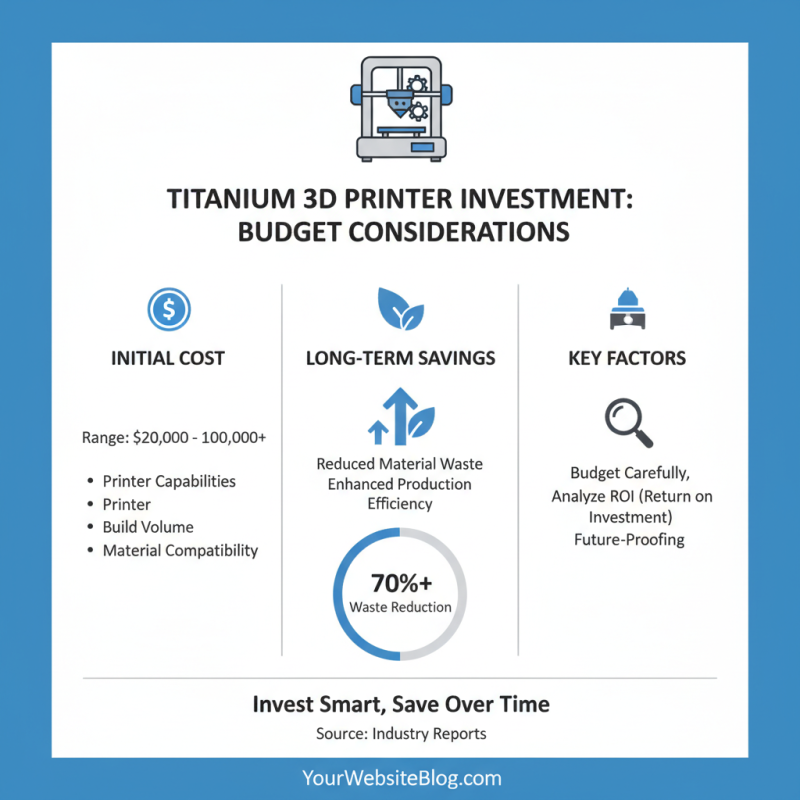
Investing in a titanium 3D printer requires careful budgeting. The initial purchase price can vary greatly, ranging from $20,000 to over $100,000. Factors influencing cost include printer capabilities, build volume, and material compatibility. According to industry reports, titanium printing can yield significant savings in the long run due to decreased material waste and enhanced production efficiency.
Consider additional expenses beyond the printer itself. Maintenance and service costs are crucial. Regular upkeep can add thousands to your yearly budget. Additionally, titanium powder is expensive, averaging $150 to $500 per kilogram. A clear understanding of your project's requirements helps in determining the overall investment.
Tips: Evaluate potential ROI carefully. Conducting a thorough cost-benefit analysis will assist with long-term planning. Ensure you account for post-processing tools and facilities, as they can impact the total expenditure. Keep an eye on market trends; prices can fluctuate based on material availability and demand. Always seek multiple quotes for materials to secure the best rates.