2026 Best Uses of Uncoated Aluminum Powder for Various Applications?
Uncoated Aluminum Powder has gained significant attention across various industries for its versatility and efficiency. According to a report from Grand View Research, the global aluminum powder market is projected to reach USD 4 billion by 2026. This growth is largely driven by the increasing demand in powder metallurgy and additive manufacturing. Uncoated Aluminum Powder, known for its lightweight properties and excellent conductivity, is crucial for applications in automotive, aerospace, and electronics sectors.
The applications of Uncoated Aluminum Powder are diverse. In construction, it enhances the performance of concrete mixtures. In the automotive industry, it contributes to lighter vehicles, improving fuel efficiency. However, challenges with oxidation and storage persist, requiring careful handling. Despite its benefits, the need for thorough understanding in specific applications is paramount. Misuse can lead to suboptimal results.
With the ongoing advancements in technology, the best uses for Uncoated Aluminum Powder are still evolving. New techniques aim to enhance its properties and applications. Industry leaders emphasize the importance of research and development to address existing limitations. As the market adapts, stakeholders must remain vigilant and informed about the latest trends to leverage this material effectively.

Applications of Uncoated Aluminum Powder in the Automotive Industry
Uncoated aluminum powder is making waves in the automotive industry. It offers unique benefits that enhance both performance and sustainability. According to a report by the Global Aluminum Association, lightweight materials can reduce vehicle weight by up to 30%. This reduction directly translates to improved fuel efficiency.
The automotive sector is increasingly focused on eco-friendly solutions. Uncoated aluminum powder is often incorporated in lightweight alloys. These alloys are crucial for electric vehicles, as they enhance the range and efficiency of batteries. A recent study highlighted that using aluminum in car parts can improve energy absorption during crashes, enhancing safety.
However, there are challenges to using uncoated aluminum powder. For instance, its reactivity can be a concern during manufacturing processes, necessitating careful handling. Moreover, the lack of a protective coating can affect its performance in certain environments. As the industry pivots toward more sustainable practices, the need for refinement in the application of uncoated aluminum powder remains critical. Enhanced practices can lead to breakthroughs in vehicle design and manufacturing, fueling innovation.
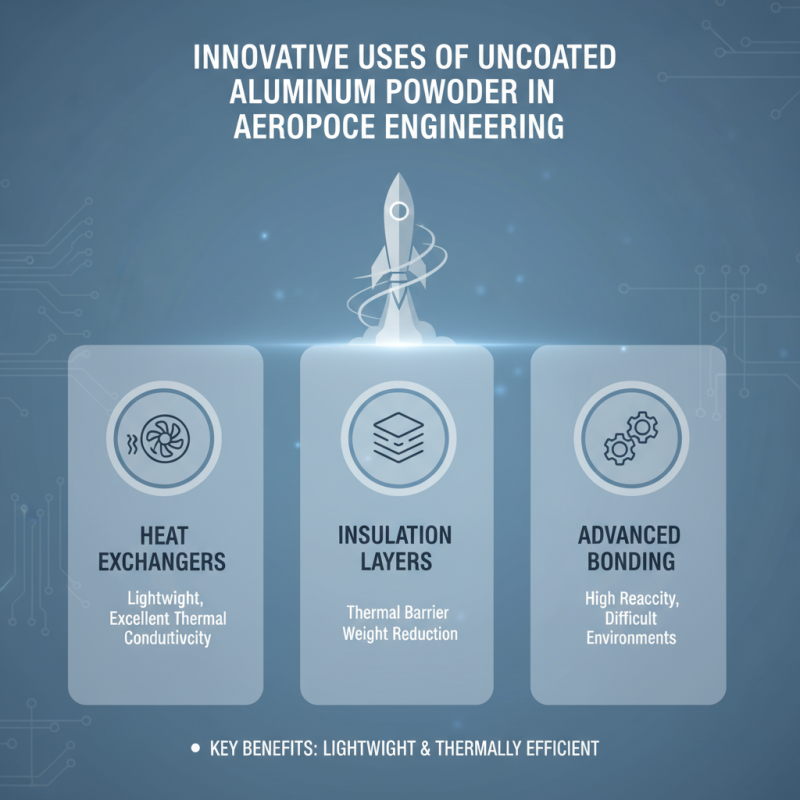
Innovative Uses of Uncoated Aluminum Powder in Aerospace Engineering
Uncoated aluminum powder is gaining traction in aerospace engineering. This material is lightweight and has excellent thermal properties. Engineers are using it for various components, such as heat exchangers and insulation layers. Its high reactivity enables effective bonding in difficult environments.
This powder can also improve fuel efficiency. When used in additive manufacturing, it allows for complex part designs. These designs reduce weight, enhancing performance. However, challenges remain. For instance, controlling particle size can be tricky. Inconsistent sizes may lead to performance variability.
While uncoated aluminum powder offers many benefits, considerations are essential. Engineers must ensure it meets safety standards. Testing under extreme conditions is necessary. This approach helps avoid potential failures during flight. Emphasizing reliability in all applications will lead to safer aerospace innovations.
Uncoated Aluminum Powder in Electronics: Enhancing Conductivity and Performance
Uncoated aluminum powder is increasingly used in electronics due to its excellent conductivity. Recent studies show that powder with particle sizes ranging from 5 to 100 microns can significantly enhance electrical performance. The unique properties of aluminum powder make it an ideal choice for conductive inks and advanced circuitry.
In electronic applications, conductivity is crucial. The use of uncoated aluminum powder can increase signal integrity and reduce energy loss. A recent industry report indicated that aluminum contributes to more than 20% of total conductive materials used in printed circuit boards. This trend reflects growing confidence in aluminum's ability to meet the demands of high-frequency applications.
However, utilizing uncoated aluminum powder is not without challenges. The powder can be prone to oxidation, which affects its performance. Maintaining the right application conditions is vital for achieving maximum conductivity. Engineers must carefully consider these factors when designing products. Balancing performance with durability remains an ongoing challenge in the industry. Addressing these concerns is essential for the future advancement of electronic materials.
Role of Uncoated Aluminum Powder in Construction Materials and Coatings
Uncoated aluminum powder is gaining traction in construction materials and coatings. Its lightweight nature contributes to overall efficiency. In fact, lightweight construction can lead to a 30% reduction in material costs. This powder has unique properties that improve both the durability and sustainability of building structures.
Research shows that aluminum powder enhances the performance of coatings. When used in protective finishes, it increases resistance to corrosion and weathering. A recent industry report indicated that coatings incorporating aluminum powder had a 25% longer lifespan than those without. This is particularly valuable in harsh environments where longevity is critical.
However, the application of uncoated aluminum powder isn't without challenges. The particle size and distribution can significantly affect performance. Optimal results require careful manufacturing processes to ensure uniformity. In some cases, improper mixing can lead to inconsistent quality. It's essential to continually assess the performance metrics in various applications to refine usage further. This balance of benefits and challenges highlights the need for further exploration in this promising area.
Environmental Impact and Sustainability of Uncoated Aluminum Powder Usage
Uncoated aluminum powder is making waves in various industries due to its eco-friendly attributes. This material has a lower environmental footprint compared to traditional alternatives. Studies show that aluminum production can result in substantial carbon emissions, about 9 tons of CO2 per ton of aluminum produced. However, using uncoated aluminum powder reduces waste and enhances recyclability. Approximately 75% of all aluminum produced is still in use today, underscoring its sustainability.
One crucial aspect of uncoated aluminum powder is its performance in applications like additive manufacturing. Here, its high strength-to-weight ratio is unmatched, promoting innovation in lightweight designs. However, the production process is not flawless. Energy consumption remains a concern, with estimates indicating that approximately 15-20% of energy used can be optimized. This reflects the need for more improved technology and practices to reduce the environmental impact further.
The health considerations associated with aluminum powder also demand attention. While aluminum is generally safe, inhalation of fine particles can pose respiratory risks. Consequently, guidelines and regulations have been established to ensure safe handling. Continuous research and observation are essential to balance performance with safety and sustainability. In this evolving landscape, stakeholders must stay vigilant and committed to sustainable practices.
2026 Best Uses of Uncoated Aluminum Powder for Various Applications
| Application Area |
Use Cases |
Environmental Impact |
Sustainability Benefits |
| Additive Manufacturing |
Used as a binder in 3D printing processes |
Low emissions during production |
Recyclable and reduces waste |
| Coatings |
Used in paints and coatings for building materials |
Non-toxic, reduces volatile organic compounds (VOCs) |
Long-lasting protective finishes |
| Composite Materials |
Reinforcement in plastics and other composites |
Can be sourced sustainably |
Enhances product lifespan |
| Pharmaceutical Applications |
Used in excipients and drug delivery systems |
Biocompatible; minimal environmental footprint |
Promotes recycling of materials |
| Electronics |
Conductive additives in electronic devices |
Energy-efficient production processes |
Supports electronic recycling technologies |