2026 Best Rapid Prototyping Materials for Innovative Designers?
The demand for innovative design solutions has led to the rapid evolution of Rapid Prototyping Materials. According to a report from Smithers Pira, the global market for rapid prototyping is expected to reach $2.3 billion by 2026. This growth emphasizes the importance of selecting the right materials to enhance product development.
Expert in the field, Dr. Emily Zhang, notes, “Choosing high-quality rapid prototyping materials can significantly impact design accuracy and speed.” Designers face challenges in finding materials that balance durability, flexibility, and affordability. Not every material is suitable for every project. For instance, some may crumble under stress, while others might not imprint accurately.
Innovators must continually evaluate their choices. The selection of Rapid Prototyping Materials needs careful reflection. A material that works for one prototype may not serve another. Striking the right balance between innovation and practicality is crucial for success in this fast-paced industry.

Overview of Rapid Prototyping and Its Importance in Design
Rapid prototyping serves as a crucial component in the design process. Designers can create physical models quickly. This allows for early testing of concepts. By using various materials, they adjust designs based on feedback. The iterative process fosters innovation. It often leads to better end products.
The importance of rapid prototyping cannot be overstated. Designers can visualize their ideas in a tangible form. This helps in identifying flaws early on. However, not every prototype leads to success. Some designs fail to connect with user needs. Reflection on these failures is vital. It promotes learning and growth in the design process.
Innovative designers must choose their prototyping materials wisely. Each material offers distinct advantages and disadvantages. Exploring different options can make a significant difference. Sometimes, prototyping can be resource-intensive and time-consuming. Yet, the insights gained often outweigh these challenges. Ultimately, the goal is to bring ideas to life effectively and efficiently.
2026 Best Rapid Prototyping Materials for Innovative Designers
| Material |
Type |
Applications |
Pros |
Cons |
| PLA |
Filament |
Concept Models, Functional Parts |
Easy to print, Biodegradable |
Low heat resistance |
| ABS |
Filament |
Functional Prototypes, Durable Parts |
High strength, Good impact resistance |
Fumes when heated |
| PETG |
Filament |
Containers, Mechanical Parts |
Good flexibility, Easy to print |
Lower layer adhesion |
| Resin |
Liquid |
Detailed Models, Miniatures |
High detail, Smooth finishes |
Expensive, Toxic fumes |
| Nylon |
Filament |
Functional Parts, Gears |
Strong and durable, Flexible |
Difficult to print, Hygroscopic |
Key Characteristics of Effective Rapid Prototyping Materials
Choosing the right materials for rapid prototyping is crucial for designers. The ideal materials need to balance speed, cost, and functionality. According to a recent industry report, about 67% of designers prioritize material versatility in prototyping. This means materials should cater to multiple applications.
Thermoplastics, like ABS and PLA, are commonly used due to their ease of use and affordability. Yet, they may lack the durability required for some applications.
Another critical characteristic is printability. Materials must be easy to process and yield high-quality outputs. An analysis conducted by the Association for Manufacturing Technology revealed that over 75% of prototyping failures stem from material-related issues. This highlights the need for effective material selection. Furthermore, while some designers may focus heavily on aesthetics, they often overlook functionality. The right material should reinforce design intent, which can sometimes be overlooked in the rush to prototype quickly.
Flexibility is another aspect to consider. Some materials can adapt to various designs, but they may not always perform well under stress. Exploring new composites can provide promising results, but they may come with a steeper learning curve. Finding that perfect balance remains a challenge, prompting ongoing reflection and adjustment.
Top 2026 Materials for Rapid Prototyping: A Comparative Analysis
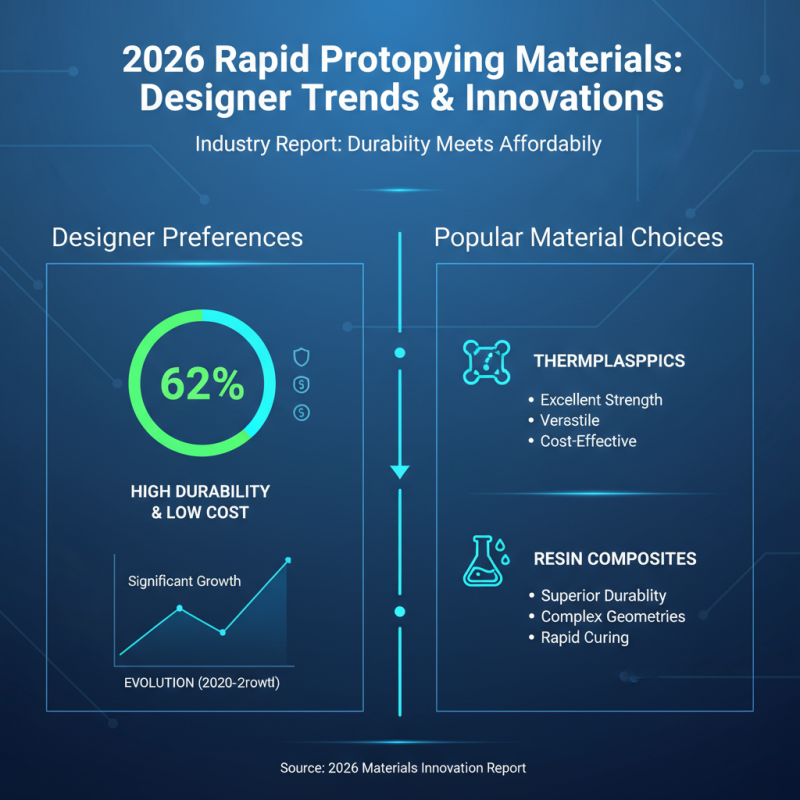
In 2026, rapid prototyping materials have evolved significantly, offering innovative designers a variety of options. A recent industry report notes that over 62% of designers prefer materials with high durability and low cost. Popular choices include thermoplastics and resin composites. These options deliver excellent strength while maintaining versatility.
However, selecting the right material can be challenging. Some designers underestimate the importance of material properties. For example, ABS plastic is often favored for its toughness, yet it can warp under heat. Understanding temperature resistance is essential for successful prototypes.
Tips: Always test your material choices on small prototypes first. A small miscalculation can lead to costly mistakes. Collaborate with peers for insight on material performance. A second opinion can unveil overlooked factors. With so many materials available, focus on your project’s specific needs, not just trends.
Case Studies: Innovative Designs Achieved Through Rapid Prototyping
Rapid prototyping has transformed design processes across various industries. Innovative designers are now using advanced materials to create functional prototypes faster. One example involves a furniture designer who utilized 3D printing to fabricate a chair. The design was intricate, featuring close interlocking pieces. However, the initial prototype faced stability issues. The designer learned that slight adjustments to the geometry were essential for strength.
Another case study highlights a fashion designer who ventured into wearable technology. By experimenting with flexible polymers, she created prototypes that responded to user movements. The concept was thrilling, but the wearability was a concern. Feedback revealed that comfort was compromised for functionality. Iterating based on user experience is vital for refining the design.
These stories illustrate the journey of innovation. Designers face challenges that require thoughtful solutions. Each prototype is a lesson, revealing strengths and weaknesses in their approach. The process teaches that perfection is not the goal; rather, evolving through feedback drives true innovation.
2026 Best Rapid Prototyping Materials for Innovative Designers
This chart displays the popularity of various rapid prototyping materials among innovative designers in 2026. The data indicates that PLA and Resin are the most favored materials, highlighting their versatility and effectiveness in prototyping applications.
Future Trends in Rapid Prototyping Materials for Designers
The future of rapid prototyping materials is bright and ever-evolving. Designers are increasingly turning to innovative materials that challenge traditional choices. Biodegradable plastics and flexible resins are gaining traction. They offer unique properties, such as improved sustainability and ease of use.
Experimentation with new composites is also on the rise. Designers are eager to blend materials to achieve desired characteristics. This can lead to more durable prototypes and lighter designs. However, the balance between functionality and aesthetic often needs reflection. Finding that sweet spot can be challenging.
As the industry progresses, it is crucial to stay informed about material advancements. Emerging technologies like 3D printing are pushing boundaries. Designers can prototype quickly. Yet, the learning curve can be steep with new materials. They may not always perform as expected. This unpredictability can spark creativity. It invites designers to rethink their approach. Embracing the imperfect will lead to innovation.